Running Your Own Race: How Chikore Students Are Learning to Measure Success by Their Own Yardstick
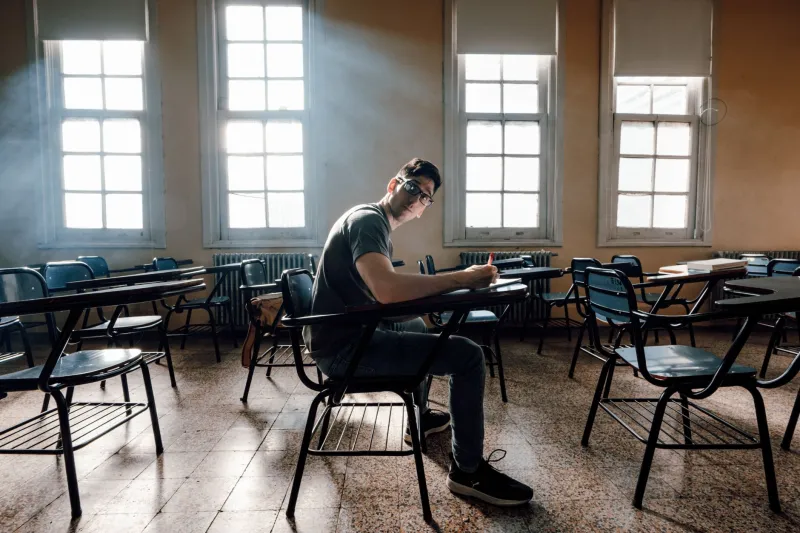
There is a moment many parents recognize instantly. Their teenager comes home from school, drops their bag by the door, and announces — with quiet defeat — that a friend scored higher on the SAT, landed a more impressive internship, or received an early acceptance letter from a school that seems impossibly out of reach. The accomplishment their child worked hard for, perhaps even celebrated just days before, suddenly feels diminished. Not because anything actually changed, but because comparison entered the room.
This is the comparison trap. And for today's high school students, it has never been more pervasive or more damaging.
The Invisible Scoreboard That Never Rests
Decades ago, teenagers compared themselves to the handful of peers they saw in the hallway or at Friday night games. Today, the scoreboard never turns off. Social media platforms serve as a continuous highlight reel — curated, filtered, and strategically timed for maximum impact. A classmate's acceptance post. A friend's athletic award. A peer's internship announcement. Each one arrives without context, without the backstory of struggle, and without the quiet failures that preceded the win.
Research consistently shows that frequent social media use among adolescents correlates with increased feelings of inadequacy and diminished self-worth. But the phenomenon extends well beyond screens. Peer culture in high school is inherently comparative — class rankings, GPA discussions, college list conversations, and even casual lunch-table talk can quietly reinforce the idea that success is a finite resource, and someone else is getting more of it.
The cost of this mindset is significant. Students who are perpetually measuring themselves against others often struggle to sustain motivation, take creative risks, or find genuine satisfaction in their own accomplishments. They stop asking, What am I capable of? and start asking, How do I compare? Those are very different questions — and they lead to very different lives.
Why Individual Trajectories Rarely Look Alike
One of the most important things educators and parents can do is help young people understand a fundamental truth: the path to a meaningful, successful life is not a single lane. It is a wide, varied landscape, and each student is navigating it from a completely different starting point, with different tools, different challenges, and different destinations.
Consider two students who both work diligently throughout high school. One excels in standardized testing and earns admission to a highly selective university. The other struggles with test anxiety but demonstrates exceptional leadership in community service and earns a scholarship to a regional college where she will thrive. Years later, both are living purposeful, accomplished lives — but their paths looked nothing alike at seventeen. Neither story is more valid than the other.
At Chikore High School, this understanding is not left to chance. It is woven into the way students are guided, counseled, and encouraged from their very first year. The goal is not to produce students who perform well relative to their peers. The goal is to develop young people who understand themselves deeply, pursue growth intentionally, and measure progress against their own prior selves — not against someone else's current position.
Practical Strategies for Breaking the Comparison Cycle
For families navigating this challenge at home, the conversation has to begin with awareness. Comparison is a natural human instinct — it is not a character flaw. But left unchecked, it becomes a habit that quietly erodes confidence. Here are approaches that educators and counselors at Chikore recommend:
Reframe the definition of a win. When your student shares a success — any success — resist the impulse to immediately contextualize it against what others are doing. A student who improved her essay score by four points after weeks of focused revision has achieved something real and meaningful. That growth deserves full acknowledgment, not a footnote.
Make personal progress visible. Encourage your teenager to keep a simple record of their own growth over time. This might be a journal, a folder of revised drafts, or even a running list of skills they have developed. When comparison creeps in, having a tangible record of personal progress creates a powerful counter-narrative.
Discuss social media with honesty. Help your teen understand that what appears online is almost never the complete picture. Behind every acceptance post is a stack of rejection letters no one shared. Behind every athletic achievement is a season of early mornings and discouraging losses. The highlight reel is real, but it is incomplete — and treating it as a full accounting of someone else's life is a distortion.
Celebrate effort, not just outcomes. Outcome-focused praise — You got an A! — inadvertently teaches students that results are what matter. Process-focused praise — I noticed how consistently you prepared for that exam — builds the internal orientation that sustains students through difficulty and helps them stay grounded in their own journey.
Encourage genuine connection over competition. One of the most effective antidotes to destructive comparison is authentic friendship. When students feel genuinely supported by their peers — rather than in competition with them — comparison loses much of its power. Chikore actively fosters this kind of community through collaborative learning environments and mentorship structures that encourage students to invest in one another's success.
What Chikore Students Are Learning to Ask Instead
The shift Chikore works to cultivate is not passive acceptance of wherever a student happens to be. Ambition and high standards remain central to the school's culture. The shift is about the direction of the measuring tape.
Rather than asking, How am I doing compared to my classmates?, students are guided to ask: How am I doing compared to who I was last semester? What have I learned that I did not know before? What challenge did I take on that I would have avoided a year ago?
These questions do not lower the bar. They relocate it — placing it somewhere far more useful and far more honest.
Students who internalize this framework tend to become more resilient when setbacks occur, more generous when peers succeed, and more capable of sustaining effort over the long arc of their education. They also tend to arrive at college and early adulthood with a clearer sense of who they are and what they value — which, in the end, is one of the most powerful advantages any young person can carry forward.
A Different Kind of Competition
At Chikore High School, we believe the most meaningful competition a student will ever engage in is the one they have with their own previous limitations. That is the race worth running. That is the standard worth chasing.
Your teenager's success story will not look like their best friend's — and it is not supposed to. It will look like theirs. And when they learn to see that clearly, something remarkable tends to happen: they stop watching other people's races entirely, and they start running their own with everything they have.
That is the student we are working to develop. And that is the graduate we are proud to send into the world.