Raising the Bar by Raising Their Hands: How Chikore High School Is Building Intellectually Courageous Learners
In most traditional classrooms across the United States, success is measured by a familiar metric: the right answer delivered at the right time. Tests are scored on what students know, not on what they wonder about. Report cards reflect recall and accuracy, rarely the willingness to probe deeper or challenge the framing of a problem itself.
At Chikore High School, educators have made a deliberate choice to rewrite that script — not by abandoning academic rigor, but by expanding what rigor actually means.
"We tell our students from day one that a well-constructed question is evidence of sophisticated thinking," says Ms. Renata Osei, who teaches AP English Language and Composition at Chikore. "When a student stops and asks, 'But wait — why are we assuming that?' they are doing exactly the kind of intellectual work that college professors and employers will expect of them for the rest of their lives."
The Problem With Treating Questions as Weakness
For many students entering high school, asking questions in class carries a social and academic risk. There is a deeply ingrained fear — reinforced by years of test-driven instruction — that not knowing something is the same as failing. Students learn, often unconsciously, to stay quiet rather than reveal uncertainty.
The consequences of this dynamic extend far beyond a single classroom. Research in educational psychology consistently shows that students who suppress curiosity in favor of answer-hunting tend to develop what scholars call surface-level processing: the ability to retrieve information on demand without genuinely understanding it. They can pass tests. They struggle, however, when problems become unfamiliar or when the "right answer" is no longer printed somewhere in a textbook.
Chikore's faculty recognized this pattern early and set out to address it structurally — not through a single program or initiative, but through a school-wide philosophical shift in how learning itself is framed.
Building a Classroom Culture Where Curiosity Has Currency
The change at Chikore did not happen overnight. It required faculty to rethink their own roles, moving away from the model of teacher-as-answer-provider and toward something closer to teacher-as-intellectual-guide.
Mr. Darian Whitfield, who leads Chikore's honors chemistry courses, describes the shift in concrete terms. "I used to feel pressure to have an answer for everything, like my authority depended on it," he admits. "Now, some of my favorite moments in class are when a student asks something that genuinely makes me pause. I model what it looks like to sit with a question, to reason through it out loud, to say 'I'm not certain — let's figure it out together.' That is far more valuable than watching me recite a formula."
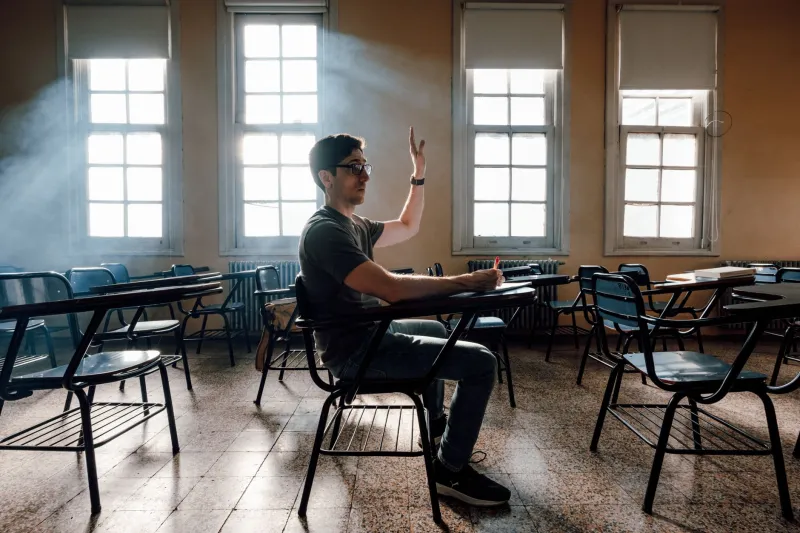
Across departments, Chikore teachers have incorporated structured question-generation into their lesson designs. Rather than opening class with a review of yesterday's material, many instructors begin by presenting a scenario, a data set, or a passage and asking students to generate their own questions before any instruction begins. The practice — sometimes called "question storming" — trains students to notice what they do not yet understand and to articulate that uncertainty with precision.
Students earn recognition not only for correct answers but for questions that push the class's thinking in a productive direction. Over time, this reframing has begun to shift the social dynamics of the classroom itself.
What Students Say It Has Done for Them
Junior Amara Delacroix recalls feeling paralyzed in her middle school science classes whenever she did not immediately grasp a concept. "I thought if I asked, everyone would know I didn't get it," she says. "Coming to Chikore and realizing that asking is actually the point — that changed how I feel about being confused. Now confusion feels like the beginning of something instead of the end."
That shift in relationship to uncertainty is precisely what Chikore's academic leadership is aiming for. Dr. Josephine Kwarteng, Chikore's Director of Curriculum and Instruction, describes intellectual courage as the connective tissue between confidence and curiosity. "Students who are willing to ask hard questions in a safe environment become students who are willing to take intellectual risks in college," she explains. "They are not rattled by ambiguity. They know how to lean into it."
Senior Marcus Tran, who is applying to engineering programs this fall, credits Chikore's question-centered approach with preparing him for the kind of open-ended problem-solving that college admissions interviewers and scholarship committees have praised in his conversations with them. "In my interviews, I kept getting asked how I approach problems I've never seen before," he says. "I actually had an answer for that, because that's basically what we do every day here."
The Link Between Question-Asking and Deeper Understanding
There is a growing body of educational research supporting what Chikore's teachers have observed in practice. Studies from institutions including Harvard's Graduate School of Education and Stanford's d.school suggest that students who are taught to generate meaningful questions — rather than simply locate answers — demonstrate stronger retention, more flexible thinking, and a greater capacity for transfer: the ability to apply knowledge learned in one context to an entirely new situation.
This matters enormously in the context of college preparation. Introductory college courses, particularly in STEM fields and the humanities, routinely present students with material that has no single correct answer. Professors in those environments reward the student who engages critically with complexity, not the one who can only perform well when the parameters are clear.
By treating question-asking as a learnable and valued skill, Chikore is equipping students with a cognitive toolkit that standardized testing was never designed to measure — but that higher education and professional life demand constantly.
Confidence as a Product of Curiosity, Not the Absence of Doubt
Perhaps the most counterintuitive outcome of Chikore's approach is what it does to student confidence. One might assume that emphasizing uncertainty — the not-knowing that drives genuine questions — would leave students feeling less secure. In practice, the opposite tends to be true.
"When students realize that their questions are taken seriously, that their wondering is treated as intellectual contribution, their confidence in the classroom grows significantly," says Ms. Osei. "They stop performing certainty they do not have and start engaging authentically with the material. That authenticity is where real learning begins."
For Amara, Marcus, and hundreds of other Chikore students, the lesson is one they carry well beyond the classroom walls: that the most powerful thing a prepared mind can do is not always deliver the answer, but know precisely which question to ask next.
At Chikore High School, that is not a soft skill. It is a cornerstone of everything the school is built to inspire.