Strength in Asking: Why Chikore High School Teaches Students to Reach Out—and Why It Changes Everything
There is a particular kind of student that educators recognize immediately. They sit in the front row or close to it. Their notes are meticulous. They complete every assignment on time. They perform well on tests and rarely, if ever, raise their hand to say they do not understand something. From the outside, they appear to have it all figured out.
But spend enough time in education, and you begin to notice something else about these students. They stay quiet during moments of genuine confusion. They rework problems alone for hours rather than ask a classmate. They decline office hours not because they have no questions, but because having questions feels, to them, like evidence of inadequacy. And when the work finally exceeds their independent capacity—as it eventually does for everyone—they are not just academically unprepared. They are emotionally unprepared.
At Chikore High School, we have made it a deliberate institutional priority to address this gap. We teach students to ask for help—not as an afterthought, but as a foundational competency.
The Invisible Barrier
The reluctance to seek support is not unique to any single type of student, but it is particularly pronounced among high achievers. The psychological literature identifies several overlapping explanations.
Perfectionism plays a significant role. Students who have built their academic identity around consistent excellence often experience confusion or struggle as a threat to that identity rather than as a natural feature of intellectual growth. Asking for help, in this framework, is tantamount to admitting failure—and failure, they have learned, is unacceptable.
Imposter syndrome compounds the problem. Many high-performing students privately believe that their success has been, to some degree, accidental. They worry that asking questions will expose them as less capable than their peers assume. The fear of being "found out" keeps them silent when silence is the least productive choice available to them.
Cultural narratives about independence also contribute. American culture has long romanticized the self-made individual—the person who figures it out alone, asks no favors, and needs no assistance. Teenagers absorb these narratives from media, family expectations, and peer dynamics. Reaching out for support can feel like a violation of an unspoken code about what strength is supposed to look like.
The result is a generation of capable, driven students who are working harder than necessary, suffering more than they need to, and developing habits of isolated struggle that will follow them into college and the workplace.
Redefining What Strength Looks Like
Chikore's approach begins with a fundamental reframing. In our classrooms and advisory sessions, we consistently communicate a message that runs counter to the dominant cultural script: the ability to recognize when you need support, and to seek it effectively, is not a sign of weakness. It is a mark of intellectual maturity and practical intelligence.
This is not merely motivational language. It is grounded in evidence. Research on expert performance across fields—from medicine to engineering to the arts—consistently shows that high achievers are distinguished not by their independence, but by the sophistication of their help-seeking behavior. They know when they are at the edge of their current knowledge. They know who to ask. They ask clearly and specifically. And they integrate the support they receive in ways that build lasting competence.
Teaching students to do the same is, in this sense, one of the most practical preparations for professional and academic life that a high school can offer.
How Chikore Makes It Explicit
At Chikore, help-seeking is not something we hope students will figure out on their own. It is something we teach directly, through structured practice and intentional design.
In advisory programming, students engage in conversations about vulnerability and intellectual courage that normalize the experience of not knowing. Faculty share their own experiences of confusion, professional setbacks, and the mentors who helped them navigate difficulty. These disclosures are not performative. They are calibrated to demonstrate, concretely, that the most accomplished people in any room have a history of asking good questions.
Students are introduced to frameworks for articulating what they do and do not understand. Rather than saying "I don't get it"—a statement that signals distress without providing useful information—students practice describing what they have already tried, where specifically their understanding breaks down, and what kind of support would be most useful. This kind of precise help-seeking is a skill, and like all skills, it improves with deliberate practice.
Mentor Relationships That Model the Process
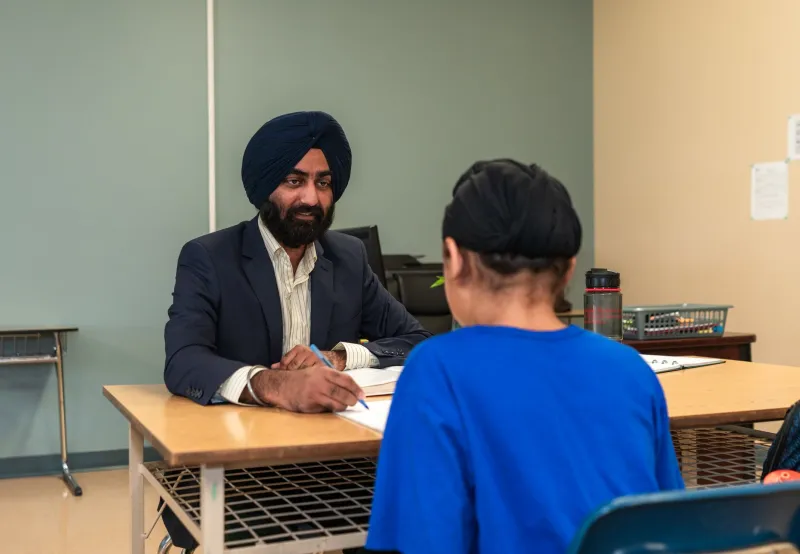
Chikore's mentorship structure is designed, in part, to give students repeated, low-stakes experience with reaching out to a trusted adult. Each student is connected with a faculty mentor who meets with them regularly in a context that is explicitly not evaluative. These are not performance reviews. They are conversations.
In that space, students practice the very behavior we are trying to cultivate. They bring questions they would not raise in a classroom. They surface doubts they would not express in front of peers. They receive guidance without consequence, and they internalize, over time, that the act of asking does not diminish them. It expands them.
Mentors are trained to respond in ways that reinforce this dynamic—acknowledging the courage it takes to surface a difficulty, providing substantive support, and consistently reflecting back to students that their willingness to engage honestly is itself a form of strength.
Peer Culture and Normalized Struggle
Individual interventions matter, but culture matters more. Chikore invests significant effort in building a peer environment where struggle is normalized rather than hidden, and where helping one another is understood as a community value rather than a competitive disadvantage.
This means creating structured opportunities for students to work through difficulty together—collaborative problem-solving sessions, peer tutoring programs, and group reflection practices where students share not just their successes but their sticking points. When a student hears a classmate they respect describe a concept they also found confusing, the isolation of private struggle begins to dissolve.
Over time, this cultural work produces something that no individual lesson can accomplish on its own: a shared understanding that the students who ask the most thoughtful questions are not the weakest members of the community. They are often the most intellectually serious ones.
Building Sustainable Paths to Excellence
The students who leave Chikore High School having learned to ask for help do not simply perform better in the short term. They are equipped with a capability that will serve them throughout their lives—in college seminars, in professional environments, and in the personal relationships that define a well-lived life.
Excellence, it turns out, is not a solitary achievement. It is a collaborative one. And the students who understand that early have a profound advantage over those who are still trying to figure it all out alone.